
Valley of Decision, The (Blu-ray Review)
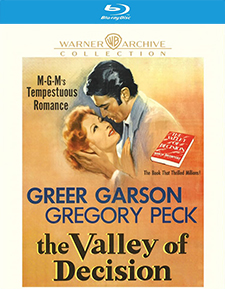
Director
Tay GarnettRelease Date(s)
1945 (December 16, 2025)Studio(s)
Metro-Goldwyn-Mayer (Warner Archive Collection)- Film/Program Grade: B
- Video Grade: A
- Audio Grade: A
- Extras Grade: B-
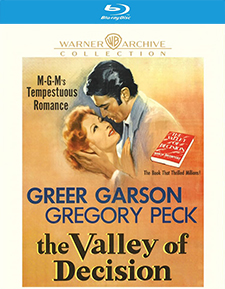

Review
During its Golden Era, MGM knew how to adapt both classics and contemporary literature to the screen with top casts and directors in the studio’s impeccable style. These films, including The Philadelphia Story, The Three Musketeers, The Picture of Dorian Gray, and The Postman Always Rings Twice, garnered both critical respect and box-office bonanzas. The Valley of Decision, based on the bestselling novel, is a period melodrama that weaves romance into a tale of dramatic changes in a major American industry.
In 1870s Pittsburgh, Marry Rafferty (Greer Garson) takes a job as a housemaid in the home of steel baron William Scott (Donald Crisp) to the fury of her father, Patrick (Lionel Barrymore), who was injured many years earlier in the Scott steel mill and has harbored resentment and hatred for that family ever since. The four Scott siblings appear to need Mary’s common sense. Constance (Marsha Hunt) is flirtatious and spoiled, enjoying the privileged life and thinking only of herself. Ted (Marshall Thompson) lives a hedonistic life and regards his upcoming enrollment in Yale merely as a chance to meet girls and party. William (Dan Duryea) is more serious and sees in Mary a calm voice of reason. Eldest sibling Paul (Gregory Peck) has taken responsibility for the day-to-day operations of the mill and enjoys the respect and friendship of the workers. Paul appreciates Mary’s honesty and wisdom and finds her a calm and soothing presence. Soon, Mary endears herself to the entire Scott family, including matriarch Clarissa Scott (Gladys Cooper).
Paul appears destined to marry socialite Louise Kane (Jessica Tandy) but as time passes, he finds himself attracted to Mary. She fears the social distance between a poor housemaid and a rich manufacturing dynasty would doom any chance that she and Paul could be happy together. Clarissa notices the bond between her son and Mary, fears Paul will ask her to marry him, and feels such a marriage cannot last. She makes arrangements to have Mary accompany newly married Constance and her husband to his home in England. Mary serves as the couple’s housemaid for two years.
Returning to Pittsburgh, Mary discovers that trouble is brewing at the mill. The workers demand better pay and working conditions and her close friend Jim Brennan (Preston Foster) is advocating for unionization. The Scott patriarch refuses to meet with Brennan to see if a compromise can be worked out. Dangerous complications ensue from the swirl of conflicts among the workers’ demands, William Scott’s stubbornness, the resentment of Mary’s irascible father, the shortsightedness and irresponsibility of the younger Scott siblings, and the desires of Mary and Paul.
The screenplay by John Meehan and Sonya Levien based on Marcia Davenport’s novel covers a decade and contains more characters than usual in a film from the 1940s. Yet, under Tay Garnett’s direction, the narrative flows smoothly even when there are occasional abrupt jumps in time. The film has the look of “important movie” because of the casting of Greer Garson, who had scored successes with Pride and Prejudice, Blossoms in the Dust, and Random Harvest and won the Best Actress Academy Award for Mrs. Miniver.
Garson was 40 when she made The Valley of Decision, too old to play Mary, who was meant to be a young woman in her late teens or early 20s at the most. Casting a name actor rather than casting by type causes the film to suffer. Garson adopts an Irish brogue that comes and goes from scene to scene. She maintains a deferential manner when Mary is working in the Scott household. Her romantic scenes with Peck are out of balance since Peck was clearly much younger. Nevertheless, both actors are so talented and skilled that they succeed in selling the romantic aspect of the picture.
The Valley of Decision was Gregory Peck’s third feature film. Handsome, self-assured and dignified, he conveys Paul’s dedication to the mill, his regard for Louise and his passion and respect for Mary. In this early film of his long career, Peck was already emanating an aura of star power and often appears a brighter screen presence than veteran Garson. His Paul is the film’s hero, as he encourages his father to end a costly and painful strike by talking with the men who work for him. When you see Gregory Peck, you automatically think of goodness and integrity, two characteristics he embodies in this film.
Lionel Barrymore is excellent as the cantankerous, angry Patrick Rafferty, confined to a wheelchair for years by an industrial accident and reviling the whole Scott family for it. Barrymore commands the screen during his scenes, seeming to have other characters wilt in his presence. Patrick is a sad, embittered, explosive man. Even if Barrymore does some scenery chewing, he provides a memorable portrayal of a man consumed by a long-held grudge.
Jessica Tandy does a fine job as Louise, unhappy and yearning to get as far away from Pittsburgh as possible. Resplendent in period dresses, her sour expression and biting delivery portray a morose stifled soul. Gladys Cooper has some touching scenes with Garson as Clarissa recognizes Mary’s inherent kindness and honesty and expresses her affection. Cooper made a career of playing rich, patrician women of a certain age. Here she makes Clarissa’s humanity shine. Young Dean Stockwell appears late in the film, after a decade has passed in the script, as a child of one of the Scott siblings.
A major problem with The Valley of Decision is its predictability. It follows the template of many dramas of the 1940s that create a degree of adversity and anguish before resolving all the problems for an upbeat ending. Some characters appear so briefly that we never get a handle on their personalities. Dan Duryea’s William and Marshall Thompson’s Ted, for instance, get little screen time to establish themselves adequately. A multiple shooting toward the end of the film is conveniently ironic because of who’s killed. Even prestige filmmaking can have its flaws.
The Valley of Decision was shot by director of photography Joseph Ruttenberg on 35mm black & white film with spherical lenses, finished photochemically, and presented in the Academy aspect ratio of 1.37:1. The Blu-ray is sourced from 4K scans of the best preservation elements. Side black mattes fill out the screen. Clarity and contrast are excellent. Backgrounds featuring the steel mill with multiple smokestacks issuing plumes of dark smoke are integrated seamlessly with foreground action. Details are evident in clothing patterns, the bridge leading to the mill, and elaborate decor in the Scott household. The Rafferty home in the sooty mill town is far more modest, with just the bare essentials. Greer Garson’s close-ups benefit from Ruttenberg’s glamour lighting. Black levels are deep and rich. Shadows are employed for dramatic effect. For the most part, however, camera angles stay at eye level even when some scenes would have benefited from more imaginative set-ups.
The soundtrack is English 2.0 Mono DTS-HD Master Audio. English SDH subtitles are an available option. Dialogue is clear and distinct. Greer Garson adopts an Irish brogue, but it isn’t consistent. None of the other characters of Irish heritage speak with a brogue. Sound effects include the heavy machinery of the mill, gun shots, horse-drawn carriages, and crowd restlessness. Herbert Stothart’s score uses romantic themes during the scenes between Mary and Paul. With the labor sequences, the music has a more urgent feel, with percussion dominant. Traditional Irish melodies are heard throughout the film underscoring Mary’s heritage. The music enhances the film’s emotional impact.
Bonus materials on the Blu-ray release from the Warner Archive Collection include the following:
- Lux Radio Theater (59:40)
- Spreadin’ the Jam (9:48)
- Wild and Woolfy (7:41)
- Theatrical Trailer (2:15)
Lux Radio Theater – This radio production of The Valley of Decision starring Greer Garson and Gregory Peck in their original screen roles was aired on January 14, 1946.
Spreading’ the Jam – Jan Clayton, Ben Lessy and Helen Boise star in this 1945 MGM short. A young woman living in a boarding house is about to be evicted because she can’t pay her rent. Fellow roomers come to her aid by throwing a rent party. Lots of singing and dancing ensue as partygoers make monetary contributions. Musicians arrive and there’s lots of jitterbugging. Even the landlady, unable to resist the fun, joins the party. From 1954 to 1957, Jan Clayton played Ellen Miller on TV’s Lassie.
Wild and Woolfy – In this 1945 MGM Technicolor cartoon directed by Tex Avery, the Big Bad Wolf is a cowboy who rides into town, terrorizes it, and kidnaps a cowgirl singer named Red after her saloon performance. This leads to a wild chase by the townspeople across the plains with Droopy continually thwarting the wolf until he finally captures him. The cartoon features zany gags, a Western theme, and Droopy’s signature deadpan expression as the hero. Tex Avery himself provides the voice of Droopy.
The Valley of Decision, shot on sound stages and the studio back lot, contains impressive sets and a first-rate supporting cast, yet it lacks the appeal of other MGM dramas of the time. We’re never fully engaged in the romantic plight of Mary and Paul, and the steel mill strike seems a contrived plot point to tie many elements together. Garson is unconvincing as a naive colleen awed by working in the grand home of a wealthy family. She was always more at home playing courageous women capable of dealing with adversity. In The Valley of Decision, she’s playing against type which is distracting and undermines the picture’s credibility. The Valley of Decision was one of MGM’s most successful films of the year, earning a profit of nearly $3.5 million, impressive for the time.
- Dennis Seuling