
Rampage (4K UHD Review)
Director
William FriedkinRelease Date(s)
1987/1992 (October 21, 2025)Studio(s)
De Laurentiis Entertainment Group/Miramax Films (Kino Lorber Studio Classics)- Film/Program Grade: See Below
- Video Grade: See Below
- Audio Grade: See Below
- Extras Grade: B

Review
Note: there are minor spoilers here for anyone who hasn’t seen both versions of Rampage, but it’s difficult to discuss the differences between the two without skirting into spoiler territory. Skip everything after the paragraph about Miramax in the film review and jump straight to the video section if you want to remain spoiler-free.
Rampage isn’t one of William Friedkin’s best-known films (due in no small part to its problematic release history), but it limns his tendencies as a filmmaker as well as anything else that he ever directed. To put it bluntly, he shifted with his own personal tides, and as a result, he could be difficult to pin down at any given moment. Some of that was due to working with different collaborators; his films that were shot by Owen Roizman look different than those featuring Andrew Lazlo, Robby Müller, Caleb Deschanel, and Robert D. Yeoman behind the camera. Similarly, working with disparate writers like Ernest Tidyman, William Peter Blatty, Walon Green, Gerald Petievich, and Tracy Letts resulted in drastically different kinds of films. Yet while there’s still a cynical brand of fatalism that runs throughout all of Friedkin’s filmography, in many other respects, his films were mercurial because he was mercurial. That’s why Rampage arguably serves as the linchpin for his entire career: it’s the film that exemplifies not just his tendency toward change, but also his tendency to rethink his own previous work.
As with much in life, that’s not what Friedkin originally intended for Rampage in 1987, but that’s how things ended up working out. It was actually a return to subject matter of the death penalty, which is what had launched his career in 1962 with the television documentary The People vs. Paul Crump. But Friedkin had changed in the decades since then, and he continued to change after 1987. The People vs. Paul Crump was an impassioned plea for clemency for a young man who had been sentenced to death for a crime that Friedkin believed he didn’t commit. (Crump was never freed, but his sentence was eventually commuted to life without parole.) Rampage was inspired by serial killer Richard Chase, aka “The Vampire of Sacramento”, who was sentenced to death in 1979 after the jury rejected his insanity defense. (Chase died of an overdose, accidental or otherwise, before the sentence could be carried out.) Unlike Crump, Friedkin felt no sympathy whatsoever for Chase, and that led to Rampage presenting a more ambiguous view of the death penalty—at least in its initial form, but we’re getting ahead of ourselves there.
To be more precise, it wasn’t so much Friedkin who was inspired by Chase as it was author William P. Wood, who wrote the 1985 novel of the same name that was the source for Friedkin’s adaptation. In the film, Charles Reece (Alex McArthur) is a seemingly normal gas station attendant who has a history of mental health issues. He snaps one morning and begins a string of brutal murders, drinking the blood of his victims afterward. When he’s finally captured by Det. Mel Sanderson (the late Art LeFleur), prosecutor Anthony Fraser (Michael Biehn) is assigned the case on the condition that he request the death penalty. Fraser and his wife Kate (Deborah Van Valkenburgh) are both devout Catholics who oppose capital punishment, but after some soul searching, he agrees to go against his conscience—reluctantly at first, but with increasing personal conviction. Reece’s attorney Albert Morse (Nicholas Campbell) mounts an insanity defense, and as Fraser presses the case before Judge McKinsey (Billy Greenbush), he finds that it’s causing increasing friction at home—leading to the prosecutor paying a penalty of his own. Or does he? That’s because the saga of Rampage was far from over once the cameras stopped rolling.
Rampage had the ill fortune of being produced under the aegis of the De Laurentiis Entertainment Group, aka DEG, and at a particularly inauspicious time for the company, too. While DEG had found some sleeper success with David Lynch’s Blue Velvet, they had an uncanny knack for producing some strikingly potent films like Michael Mann’s Manhunter and Kathryn Bigelow’s Near Dark and then utterly failing to market or distribute them with any real savvy. By 1987, DEG was in dire straits, and they ended up halting theatrical distribution entirely, with their remaining slate either going direct-to-video or else being sold off to different distributors. Rampage was screened a few times, but it was never officially released in the United States—not for another five years, anyway.
Miramax eventually acquired the film and released it in 1992, but not in the same form that Friedkin had intended back in 1987. Yet despite the Weinsteins’ well-deserved reputation for maladroit tinkering, the catalyst for many of the changes was Friedkin himself. The original version of Rampage was hardly subtle (the courtroom scenes are borderline laughable at times), but it still offered a relatively nuanced view of arguments for and against the death penalty, without firmly landing on either side of the debate. Not so with Friedkin’s Miramax recut, which takes a markedly pro-death penalty perspective and hammers that point home with the same kind of subtlety that the director had brought to the gay S&M scene in Cruising (in other words, none whatsoever). The DEG cut may not have been particularly subtle, but the Miramax cut is a screed that argues for the death of a man with the same singlemindedness that Friedkin had used to try to save another man’s life with The People vs. Paul Crump.
While there are small changes throughout, the biggest differences are contained in the opening and closing sections. The original film opens with Reece simply slaughtering a family out of the blue for no other reason than his self-perceived need for human blood, but the recut adds a scene where he goes to buy the gun from a dealer (Chris Mulkey). He lies about his own history of mental illness when purchasing it, so the scene establishes his premeditation and willingness to conceal the truth in order to bring his desires to fruition. While the ending of the original aligned with what had happened to the real Richard Chase, the recut leaves him alive in prison with the implications that he could be released some day and kill again. In the recut, the real tragedy isn’t the murders that Reece commits; it’s the fact that the state isn’t allowed to put him to death as a result of his actions.
Yet while the other changes throughout the recut of Rampage may be smaller, they have an even bigger impact on the film’s point-of-view. Friedkin softened or completely removed a variety of scenes where Fraser questions his own commitment to securing the death penalty, including a key moment where the results of a new PET scan make him express real doubts that he did the right thing. Friedkin also softened his strained relationship with his wife Kate, and deleted a scene near the end where she decides to leave him. Ironically enough, while the original version maintained an ambiguous perspective regarding the morality of the death penalty, it was unambiguous about the impact that Fraser’s vacillating beliefs had on his personal life. In comparison, the recut removes all ambiguity about Fraser’s newfound belief in the efficacy of the death penalty, but it muddies the personal impact that he faces as a result (and it leaves Kate out in the cold in the process).
Ultimately, the original version of Rampage is a stronger film, but both versions provide a window into Friedkin’s soul. The film changed as he changed, and the experience had a profound impact on him—for good or for ill. Once he caught the bug of being able to revise his previous work, he never turned back. The recut of Rampage led to The Version You’ve Never Seen recut of The Exorcist in 2000, and he made various audio, visual, and editorial changes to some of his other films as well. (The less said about his non-Owen Roizman approved regrading of The French Connection, the better.) Rampage isn’t Friedkin’s best film, and it’s certainly not his most important, but it’s arguably his most significant film in terms of how it reflects who he was in 1987, the person that he changed into by 1992, and what he became for the rest of his career. It’s an essential film in order to understand this exceptionally mercurial director.
(For a detailed breakdown of all the differences between the two primary versions of Rampage, see the “Original Cut/1992 Recut” page at Movie-censorship.com.)
Cinematographer Robert D. Yeoman shot Rampage on 35mm film using spherical lenses, framed at 1.85:1 for its theatrical release. The DEG version here is based on 4K scans of the original camera negative, while the recut version is based on 4K scans of Miramax’s 35mm interpositive instead. Both versions are graded for High Dynamic Range in Dolby Vision and HDR10. The original has had minimal cleanup performed, as there’s persistent speckling and other light damage marks throughout. The recut version is cleaner, but the tradeoff is that the textures show slightly less detail due to the generational loss involved. On the whole, the original looks better overall despite the minor damage, although everyone’s mileage may vary in that regard. (Both films are encoded separately on a single disc, so the bitrate is modest, but it doesn’t appear to cause any major issues.)
On the other hand, the HDR grade on the original version tends to run a little hot, with highlights that sometimes look slightly blown out, and flesh tones that can veer too reddish. The contrast and colors on the recut version look more natural overall (although there’s arguably a touch more shadow detail present on the original thanks to the direct scan from the negative). Strictly from the perspective of video quality, each of these presentations has their strengths and weaknesses, enough so that they offset each other in terms of giving them a letter grade. I preferred the colors on the recut version but the clearer detail on the original, but once again, your own mileage may vary. In any event, most people will have a clear preference for one or other of the cuts (most likely the original), so that will take precedence over any variations in image quality.
There is one important sidebar regarding this release of the original cut. Compared to the U.K. and German VHS versions, there are two brief missing scenes here: the first is when Reece is watching the court stenographer and starts to fantasize about her; the second is when he gives a speech to the jury after their verdict, expressing apparent remorse for what he did. The reason(s) why they’re missing is unclear. It could simply be a mistake of some kind, but it’s entirely possible (and arguably more likely) that those scenes don’t exist on the extant negative—meaning that there’s actually a third version of the film. The scenes could have been added for international home video, or else the international theatrical cut may have been different than the domestic cut that was screened but never actually distributed. Friedkin is gone at this point, so there doesn’t appear to be any way of determining the truth (and he wasn’t exactly a reliable narrator when it came to his own films anyway). Regardless, it’s a shame that those scenes aren’t included here in one form or another, even if just as deleted scenes.
(Refer to the “Original Cut/German VHS” page at Movie-Censorship.com for a breakdown of these scenes.)
Audio for both versions is offered in English 2.0 and 5.1 DTS-HD Master Audio, with optional English subtitles. Rampage was originally released in Dolby Stereo, both in 1987 and 1992, and these do appear to be the Dolby stereo mixes while the 5.1 are relatively straightforward discrete encodings. Either way, the dialogue relied heavily on ADR, enough so that parts of the film sound like they were dubbed into English. The voices just don’t integrate well into the soundstage, at least on a consistent basis. Where the mix shines, however, is in Ennio Morricone’s score, which remains one of his finest (certainly his most underappreciated) works. Morricone was a master at creating unease through subtle use of dissonance and atonality, and his score for Rampage is an absolute masterclass in that regard.
ORIGINAL 1987 VERSION (FILM/AUDIO VIDEO): B/B+/B+
RECUT 1992 VERSION (FILM/AUDIO/VIDEO): C+/B+/B+
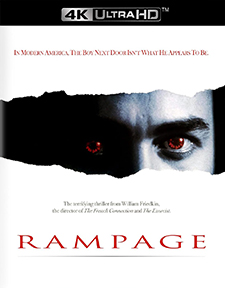
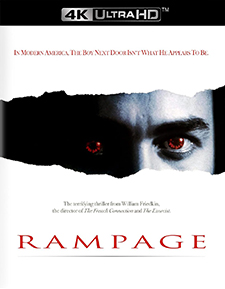
The Kino Lorber 4K Ultra HD release of Rampage is a two-disc set that includes a Blu-ray with a 1080p copy of the film. There’s also a slipcover that duplicates the theatrical poster artwork on the insert. The following extras are included:
DISC ONE: UHD
- Commentary by Howard S. Berger and Nathaniel Thompson (Original)
- Commentary by Howard S. Berger and Nathaniel Thompson (Recut)
DISC TWO: BD
- Commentary by Howard S. Berger and Nathaniel Thompson (Original)
- Commentary by Howard S. Berger and Nathaniel Thompson (Recut)
- Where’s the Blood? (SD – 16:06)
- Psychotic Vampire (SD – 19:14)
- Trailer (HD – 1:04)
- To Live and Die in L.A. Trailer (HD – 2:08)
- Rules of Engagement Trailer (Upscaled SD – 2:21)
- The Hunted Trailer (SD – 2:22)
- Bug Trailer (HD – 1:22)
Kino has included new commentaries by Howard S. Berger and Nathaniel Thompson, though in the best Friedkin tradition, it’s really one basic track that’s been modified to fit the alternate cuts. (The biggest differences are during the opening and closing sections of the film.) They compare the two versions, noting that the Miramax version became a polemic without any subtlety—it’s about finding justice, not trying to persuade the viewer. The original was less single-minded in its aims. They expand from that into a broader discussion of directors tinkering with their work, bemoaning the fact that some filmmakers like Michael Mann and the Coen brothers are actively trying to erase the previous versions of their films. At least in this case both versions are being included. (Berger correctly notes that Friedkin’s added sound effect at the end of Sorcerer ruins the entire film, but in that instance the new Criterion UHD does offer the original 4-track stereo mix.) Berger and Thompson also break down Rampage thematically and highlight some of its underappreciated supporting cast like Billy Green Bush, Nicholas Campbell, and Deborah Van Valkenburgh. It’s more of an appreciation of Rampage than dry details about the making of it, but that’s exactly the kind of thing that a film like this needs.
Where’s the Blood is an interview with Alex McArthur, who explains the way that he ended up getting into acting and how appearing in Madonna’s Papa Don’t Preach music video led to his role in Rampage. He talks about working on the film and tells a couple of stories about Friedkin’s working methodology (including striking Grace Zabriskie before a scene, which does sound like something that Friedkin would have done). He also discusses the two versions of the film—although he acknowledges that he doesn’t even know how the recut version ends.
Psychotic Vampire is an interview with Harold Schechter, professor emeritus queens at Queens College, and author of various true crime books like Deviant: The Shocking True Story of Ed Gein, the Original Psycho. He discusses the nature of our attraction to morbid subject matter throughout human history, and he became aware of Richard Chase while researching belief in vampirism for his book The Serial Killer Files: The Who, What, Where, How, and Why of the World’s Most Terrifying Murderers. Chase wasn’t a traditional psychopath like other serial killers, just schizophrenic, and he made little attempt to hide the evidence of his crimes or to disguise his morbid proclivities—which proved crucial in the legal determination that he wasn’t insane (insanity isn’t a clinical assessment, but rather a legal one). Schechter breaks down some of the similarities and differences between Chase and the version of his story as presented in Rampage. He feels that all the characters in the film were written in a way that Friedkin intended to reinforce his point of view about the insanity defense and the death penalty. He admits that he wasn’t impressed by the film on a first viewing, but it improved for him after he revisited it.
Revisiting Rampage is crucial in order to fully appreciate what Friedkin was trying to achieve (even if his own intentions were somewhat muddy). It’s just not a film that works well after a single viewing. Thankfully, since Kino Lorber has now preserved both cuts in full 4K, you can watch them both back-to-back in order to assess the differences and decide for yourself which version works better. Recommended for open-minded Friedkin fans who are willing to put some effort into meeting a film (or films) on its own terms.
-Stephen Bjork
(You can follow Stephen on social media at these links: Twitter, Facebook, BlueSky, and Letterboxd).