
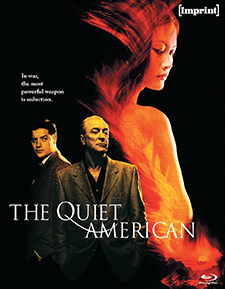
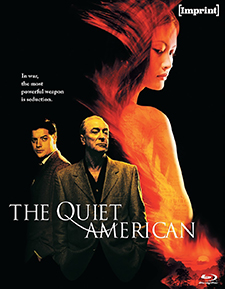
Quiet American, The (Blu-ray Review)
Director
Phillip NoyceRelease Date(s)
2002 (October 29, 2025)Studio(s)
Miramax Films/Intermedia Films (Imprint Films/Via Vision Entertainment)- Film/Program Grade: A
- Video Grade: A-
- Audio Grade: A-
- Extras Grade: B+

Review
[Editor’s Note: This is a Region-Free Australian Blu-ray import.]
Adapted from Graham Greene’s 1955 novel, The Quiet American (2002) received rave reviews when it was new, particularly for the leading performances of Michael Caine and Brendan Fraser, though I was surprised to read many commenting on the IMDb and elsewhere that they found the film too confusing and uninvolving. That’s like calling Greene’s The Third Man (1949) too confusing and uninvolving, especially insomuch as their stories are structurally similar.
Greene’s novel was popular in Britain but largely condemned in the U.S. as anti-American because of its cautionary tale of American interventionism in Vietnam near the end of the First Indochina War and its criticism of American exceptionalism. A 1958 film version directed by Joseph L. Mankiewicz perversely inverted Greene’s themes, turning its undercover CIA antagonist (played by a well-cast Audie Murphy) into the hero, its British protagonist into a villain. Incredibly, Mankiewicz wrote the script in collaboration with CIA operative Edward Lansdale, the very inspiration for Greene’s title character. It also didn’t help that another of the film’s central characters, a beautiful Vietnamese woman, was in that film played by an Italian.
The 2002 version, directed by Phillip Noyce and adapted by Christopher Hampton and Robert Schenkkan, rectifies that appalling cinematic injustice. The newer film is faithful both to Greene’s novel and its political themes. It’s one of the most unjustly overlooked films of the last 25 years.
In 1952 Saigon, as French forces fight a losing battle against the Communist-led Viet Minh, aging, cynical, but apolitical British journalist Thomas Fowler (Michael Caine) files the occasional story to his London newspaper but mostly enjoys life with his decades-younger mistress, beautiful Phuong (Do Thi Hai Yen). Clearly, Fowler is deeply in love with Phuong, though he’s married to a Catholic back in London who refuses to divorce him.
Fowler meets American aid worker and idealist Alden Pyle (Brendan Fraser), who claims to know nothing about Vietnam nor speak the language, but whom Fowler quickly suspects of being a CIA operative. They become close friends, especially after Pyle saves Fowler’s life following an apparent Viet Minh attack, this despite the fact that Pyle openly wants to steal Phuong away from him, brazenly assuming she’d dump the old man for him in a heartbeat. For her part, Phuong seems quite content with Fowler and may even love him, at least until he lies to her, he claiming his wife back in England has finally agreed to a divorce. In any case, everything changes in the wake of a shocking terrorist attack in central Saigon that kills dozens of innocent civilians.
The Third Man revolves around a naïve, middle-aged American (Joseph Cotten) with a far worldlier and more sinister boyhood friend (Orson Welles), the former attracted to the friend’s exotic mistress (Alida Valli), the naïve American eventually becoming involved in plotting the eventual killing of his friend. The Quiet American uses these same basic components, but ingeniously twists them all around. Unlike The Third Man, The Quiet American explores the love triangle aspects more deeply and intriguingly. Fowler has no illusions about this relationship, that though Phuong is loving and attentive, and really seems to enjoy Fowler’s company, he realizes that, for her, the relationship is also transactional, that she stays with Fowler primarily because of the financial security he provides.
In the novel Fowler was in his 50s but Caine was in his late 60s when the film was made. This actually enhances the story’s credibility because the more extreme age difference makes their relationship even more tenuous—How much longer will he be able to provide for her? What if he gets sick or dies? That makes her gravitating toward Pyle, and Fowler’s semi-acceptance of it in the early scenes, he wanting to protect Phuong’s future, more believable, not less. The strangely warm friendship Fowler and Pyle maintain in spite of Pyle’s blunt and clumsy declarations of love toward Phuong also intrigues. Fowler, older, more experienced and confident of his standing with Phuong, doesn’t feel threatened in the beginning, thinks maybe she’s better off in the long run with Pyle in the middle, then desperately wants her back once he fully comprehends the amoral roots of Pyle’s character.
The political half of The Quiet American is equally well-told, a welcome restoration of Greene’s prescient novel so perverted in the 1958 film. And it’s still relevant: the film was first test-screened to a rave response on September 10, 2001—but the 9/11 attacks the following day caused Miramax to shelve the “unpatriotic” film for an entire year. Though it received positive reviews in late 2002 and even an Academy Award nomination for Michael Caine, few people then connected its CIA-manufactured terrorism, erroneously blamed on the Viet Minh to sway public opinion for U.S. intervention in Vietnam, with the equally and disastrously manufactured consent derived from threats of “weapons of mass destruction” falsely claimed to justify the Iraq War. Or, for that matter, claims of alleged drug smugglers to justify a war with Venezuela. Graham Greene predicted all this 70 years ago.
Another thing that irked Americans in 1955 (and today), was undoubtedly Pyle cocksureness of American righteousness, a true believer so virulently anticommunist he justifies American-instigated terrorist attacks killing scores of innocent civilians, including women and children. Brendan Fraser’s performance surprised many who knew him primarily from frivolities like George of the Jungle and not Gods and Monsters. But it’s Michael Caine, in another extraordinarily subtle, late-career performance, that really holds the film together. Perhaps drawing on his long-lasting marriage to Shakira, the Guyanese beauty born to Indian-Muslim parents, Caine’s scenes with Do Thi Hai Yen, also excellent, are unusually convincing and heartfelt.
Perhaps not surprisingly, while the 1958 version of the story has been released twice on Blu-ray from two different labels, this newer version has not, at least not in the U.S., though there was a 2011 release in the U.K. by StudioCanal. Confusing things further is that while The Quiet American had a running time of 118 minutes during its theatrical run, all subsequent home video and broadcast versions are cut to 101 minutes, including here. Even in its shorter form The Quiet American is plenty powerful and it didn’t feel like anything critical was missing (descriptions of the deleted scenes would seem to confirm this), but I would have preferred seeing the complete theatrical version.
Australian label Imprint’s Region-Free disc may be the same 1080p transfer used for the StudioCanal release. Filmed in 2.35:1 Super 35, the image looked good even on my big projector/screen system, though there’s definitely room for improvement. Still, it captures the Vietnamese locations well, has decent color and contrast throughout. The DTS-HD Master Audio (5.1) is likewise fine, though one might want to adjust the volume in the surround channels, which seem mixed a little too low to my ears. An LPCM 2.0 stereo track is also offered, along with optional English subtitles.
The supplements mostly appear to be repurposed from the 2011 release. They consist of an audio commentary track featuring Noyce, Caine, and Fraser, as well as co-writer Hampton and Tzi Ma (who plays Caine’s assistant at the newspaper office), producers Sydney Pollack, Staffan Ahrenberg, and William Horberg, as well as interpreter Tran An Hua; Anatomy of a Scene, a Sundance Channel-made featurette; a making-of featurette; an interview with director Noyce; cast and crew interviews (prepared for television syndication, obviously); Fox Studios and Vietnam B-roll footage; and a trailer.
An exceptional film ripe for rediscovery, The Quiet American is highly recommended.
- Stuart Galbraith IV