
Jade (4K UHD Review)
- Review Date: Aug 12, 2025
- Format: 4K Ultra HD
-


Director
William FriedkinRelease Date(s)
1995 (July 29, 2025)Studio(s)
Paramount Pictures (Vinegar Syndrome)- Film/Program Grade: See Below
- Video Grade: See Below
- Audio Grade: See Below
- Extras Grade: B

Review
When William Friedkin met Joe Eszterhas, something was bound to give, and give it did. The creative intersection between a maverick filmmaker and an equally egotistical screenwriter was bound to result in some creative friction, and that’s exactly what happened. Eszterhas’ career was still on the rise at that point after his record-setting $3 million payday for the script to Basic Instinct, and while Sliver put a bit of a dent in that, that didn’t stop Paramount chairperson Sherry Lansing from paying Eszterhas $1.5 million for a two-page treatment to Jade. (To be fair, Sliver was still in production at that point.) Lansing set up a deal with Robert Evans producing, and the script ended up in the hands of William Friedkin, a man who never met a script that he didn’t feel like tweaking. Depending on who you believe, he ended up rewriting most or even all of it to suit his own tastes. Yet the film that was ultimately released in 1995 still feels like a Joe Eszterhas Joint, through and through.
The convoluted story for Jade revolves around the investigation into the murder of a prominent businessman, who was brutalized with an antique hatchet taken from his own collection. Assistant District Attorney David Corelli is brought onto the scene in order to aid the investigation, which uncovers clandestine photographs of Governor Lew Edwards (Richard Crenna) having sex with a prostitute (Angie Everhart). That puts Corelli on a tightrope between the Governor, the Governor’s assistant (Holt McCallany), the District Attorney (Kevin Tighe), and the various police officers involved in the investigation (Michael Biehn, Donna Murphy, Ken King, and David Hunt). Worse, further evidence implicates psychologist Anna Katrina Maxwell-Gavin (Linda Fiorentino), an ex-lover of Corelli’s who is currently married to his friend Matt Gavin (Chaz Palminteri). As things heat up, Corelli finds himself not just walking a tightrope, but standing in the crosshairs.
Since Jade is an erotic thriller from the mind of Joe Eszterhas, Friedkin decided to give the film his version of a Paul Verhoeven gloss, with lavish sets, costumes, and set decoration. James Horner’s score even channels Jerry Goldsmith at times (that’s when it’s not openly using Stravinsky’s Le Sacre Du Printemps and the Loreena McKennitt song The Mystic’s Dream instead). Friedkin also filled the film with intentionally unstable camerawork in order to keep viewers off kilter. Like the killer, Andrzej Bartkowiak’s camera is constantly on the prowl throughout all the lavish environments, never settling in one place for too long—and in that respect, Friedkin displays as much of a giallo influence as he does Verhoeven (something that he has previously toyed with in Cruising). There’s plenty of unconventional framing and Dutch angles, too. Jade may lack narrative coherency, but it doesn’t lack for style.
Befitting a Joe Eszterhas script (regardless of whether or not it was rewritten by someone else), Jade has plenty of questionable police procedures and legal maneuvering on display. Yet it’s not really a police procedural anyway, so it’s best not to take any of that too seriously. It’s an erotic thriller, after all, regardless of the dubious nature of some of the eroticism that it offers. And befitting a William Friedkin thriller, there’s also a car chase, although Friedkin handicapped himself by shooting it in the well-trod territory of the San Francisco streets—if you’ve seen one car sailing over the top of a hill, you’ve seen them all. (Short of doing something unusually creative like the radio-controlled car chase in The Dead Pool, there was no way that Friedkin could overcome that familiarity to create a chase as innovative as the ones that he had already crafted for The French Connection and To Live and Die in L.A.) It all leads to a clumsily staged finale that’s as confused (and confusing) as anything that Friedkin ever shot, pushing intentional ambiguity to the edge of borderline incomprehensibility.
Given all of that, it’s not too surprising that Jade received overwhelmingly unfavorable reviews, flopped at the box office, and was the recipient of two Golden Raspberry nominations for 1995. (And it’s even less surprising that it ended up losing in both categories to Paul Verhoeven’s Eszterhas-scripted Showgirls.) The knives were already out for Eszterhas at that point, and William Friedkin was caught in the crossfire. Yet as with many such things, the negative reaction to Jade was way out of proportion to the quality of the film itself. No, it’s not exactly a misunderstood masterpiece, but it’s still a slick, stylish thriller that makes up for its lack of narrative coherency with a certain amount of verve. For once, it’s a case where appreciating a film at face value is better than trying to read anything deeper into it. Take that as you will.
(Note that none of that changes significantly regardless of which version that you see. The international release offered some slightly more graphic sex that was trimmed in the United States in order to avoid an NC-17 rating, while Friedkin also supervised an extended cut for VHS that added that material plus a few other scenes and scene extensions, including an alternate coda that takes place after the ending of the theatrical cut. It was billed as a “director’s cut,” but there’s no real evidence that the theatrical version wasn’t already the director’s cut—no one at Paramount had a gun to Friedkin’s head. Yet he was always open to revisionism when given the opportunity, so revise he did. Regardless, none of the changes that he made have a significant impact to the film as a whole, although the coda is arguably a small step backward.)
Cinematographer Andrzej Bartkowiak shot Jade on 35mm film using Panavision Panaflex cameras with spherical lenses, framed at 1.85:1 for its theatrical release. For this version of the theatrical cut, the original camera negative was scanned at 4K, digitally cleaned up, and graded for High Dynamic Range in both Dolby Vision and HDR10. Since the negative was cut to conform to that theatrical cut, the so-called “director’s cut” is a hybrid version that utilizes the negative scans wherever possible, but substitutes 4K scans from two different interpositives as necessary for most of the missing material. Yet two shots couldn’t be located, so upscaled inserts from the old SD video master of the extended version were used for them instead (needless to say, they’re impossible to miss). Friedkin wasn’t happy with the original home video grades of Jade, so this version has been regraded to match what Vinegar Syndrome calls his “original artistic intentions” (given his proclivity for revisionism, take that with as many grains of salt as necessary).
In keeping with the heightened style of the film, this version of Jade is loaded with bright, saturated colors, making everything look larger-than-life. Jade isn’t a subtle film, so whether or not it really does match Friedkin’s original intentions for the film, the vivid colors make perfect sense. A few of the green grasses verge on looking oversaturated, but everything else looks appropriate, flesh tones included. There’s no remaining damage of note, and while the upscaled SD shots in the “director’s cut” do stick out like a sore thumb, the IP footage integrates quite well and is only noticeable if you go looking for it. The only real issue is some noise creeping into the darker shots, especially during the final confrontation in both versions, which is swarming with chroma noise that threatens to smother the natural film grain. That may not be as noticeable on all systems, however. Taken as a whole, this is a significant upgrade for Jade.
Audio for both cuts is offered in English 5.1 and 2.0 DTS-HD Master Audio, with optional English SDH subtitles. Jade was released theatrically in Dolby Digital 5.1, but there would have been a backup Dolby surround-encoded 2.0 mix for theatres that weren’t yet equipped for digital, and presumably the 2.0 track here is the same mix rather than a fold-down of the 5.1 (I didn’t spend much time with it since the main mix was 5.1). Note that for some reason, the “director’s cut” defaults to 2.0, but it can still be switched to back 5.1 manually. (When doing so, there are actually two different 2.0 tracks, which may have been necessary in order to encode the audio selections for the different menus, but they sound identical.) In 5.1, there’s a fairly wide stereo spread and consistent ambience throughout, although it’s still not the most aggressive of 5.1 mixes from that era. James Horner’s score is the star of the show, providing much of the sonic energy throughout the film—after all, no one is here for the dialogue, amirite?
THEATRICAL CUT (FILM/VIDEO/AUDIO): C+/A-/B+
DIRECTOR’S CUT (FILM/AUDIO/VIDEO): C+/B+/B+
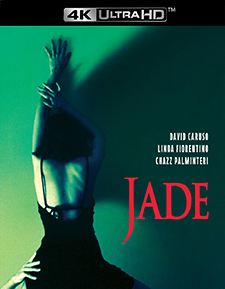
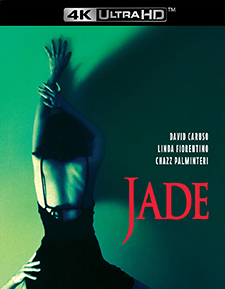
Vinegar Syndrome’s 4K Ultra HD release of Jade is a two-disc set that includes a Blu-ray with a 1080p copy of the film. They’re also offering a Limited Edition version featuring a spot gloss hard slipcase and slipcover combo designed by Adam Maida, as well as a 40-page booklet with essays by Marya E. Gates, Charles Bramesco, Juan Barquin, and Justin LaLiberty. That version is available directly from Vinegar Syndrome and at a few select retailers, limited to 8000 units (there are still 2000 left as of this writing). The following extras are included:
DISC ONE: UHD
- Audio Commentary with Jennifer Moorman
DISC TWO: BD
- Audio Commentary with Jennifer Moorman
- Eszterhas, Friedkin, and Jade (HD – 7:02)
- Hysterical Blindness: William Friedkin at Paramount (HD – 22:07)
- William Friedkin Interview (Upscaled SD – 12:58)
- Original Trailer (Upscaled SD – 2:53)
Vinegar Syndrome has added several new extras for this release of Jade, starting with a commentary by Fordham University scholar Jennifer Moorman, who specializes in questions of gender, sexuality, race, class, and ability in film and other media. She addresses most of those issues in her commentary, and also breaks down the story (including many of the changes that were made to it during rewrites). She’s definitely more interested in Jade on a visual and thematic level than she is in recounting the tortured tale of its making, but she does give a few tidbits here and there. She covers Friedkin’s claims that he rewrote the entire script, but says that it still feels like the work of Joe Eszterhas (which says a lot about Eszterhas!) Still, it’s Moorman’s analysis that’s the draw here, and she offers an interesting breakdown of the erotic thriller genre from that era and how Jade does (and doesn’t) fit comfortably into it.
Eszterhas, Friedkin, and Jade gives the writer the opportunity to tell his own version of the story. He details the history of his original treatment and script, including how Sherry Lansing eventually bought it at Paramount and brought in Friedkin to direct. According to Eszterhas, Friedkin initially said that he wasn’t going to change a comma of the original script, but that’s just not how it worked out. Yet Eszterhas doesn’t put the failure of the film entirely on Friedkin, admitting that he made the mistake of listening to his own press after Jagged Edge and Basic Instinct, and his personal life was also bottoming out at that point (happy ending, though, since he cleaned up and got married to a person he’s still with to this very day).
Hysterical Blindness: William Friedkin at Paramount is an interview with editors Augie Hess and Darrin Navarro, who explain the complicated history of editing during that period with the transition from editing on film to using digital nonlinear systems like Lightworks (Friedkin’s Blue Chips was edited both ways). Yet for all of the screenwriting chaos with Jade, the actual shooting and editing of it went pretty smoothly (although they have a few unkind stories to tell about producer Bob Evans). They reinforce the point that Friedkin had final cut and the theatrical cut is every bit his own version, with the studio being responsible for pushing the extended cut for home video. They also provide a portrait of Friedkin as a person, with Navarro describing the director as the most cordial filmmaker he’s ever worked with, at least until he wasn’t: when things went wrong, Friedkin could indeed became unbearable. The key was to get everything right the first time.
Finally, the William Friedkin Interview is an excerpt from the October 20, 1995 episode of The Charlie Rose Show. They spend a lot of time talking about his early work as a documentary filmmaker and some contemporary documentaries, but they do eventually move from that to Jade. Friedkin shows off a clip from the film and offers special praise for Linda Fiorentino.
Vinegar Syndrome has never been afraid of giving some serious 4K love to much-maligned films—vide their elaborate special edition for Showgirls—but it’s still nice to see them giving that same kind of love to Jade. It’s never really gained as much of a cult following as some of their other titles, good, bad, or ugly, but having it in a shiny new 4K wrapper certainly doesn’t hurt. Rewatch it with an open (but empty) mind, and you might be surprised.
- Stephen Bjork
(You can follow Stephen on social media at these links: Twitter, Facebook, BlueSky, and Letterboxd).