
Hell’s Angels (4K UHD Review)

Director
Howard Hughes, James WhaleRelease Date(s)
1930 (November 18, 2025)Studio(s)
The Caddo Company/United Artists (The Criterion Collection – Spine #1288)- Film/Program Grade: B+
- Video Grade: A-
- Audio Grade: A
- Extras Grade: A

Review
[Editor’s Note: The majority of this review was originally written by Dennis Seuling. The video review portion is written by Tim Salmons.]
Hell’s Angels, Howard Hughes’ homage to World War I fighter pilots, is still revered nearly a century later for its breathtaking sequences of daredevil aerial footage. Production started during the silent era but extensive delays caused the film to be updated for sound and released in 1930. The film is largely in black & white with some impressive scenes in color.
In England on the eve of World War I, brothers Roy (James Hall) and Monte (Ben Lyon) discuss with German pal Karl (John Darrow) the growing tensions between the two countries. Karl, a foreign exchange student, feels loyalty to his native land even though England has been a welcoming second home to him. Soon, all three find themselves swept up into their respective homeland’s burgeoning air forces.
Roy and Monte enlist, less for patriotism than for the social pressure they feel from women and the elderly. A pretty young woman stands by the enlistment board offering kisses to any man who signs up, and there are many takers. Once in uniform, the brothers seek out women and both set their sights on socialite Helen (Jean Harlow)—Roy because of her innocent look and Monte because of her suggestive flirtations. Meanwhile, Karl has returned to Germany and become a spotter for bombing missions over England.
The soap opera plot is a routine device to spice up the intervals between scenes of biplanes in battle. Harlow’s line deliveries are amateurishly awkward but her screen presence is strong. Hell’s Angels would be a breakthrough role for her. As the brothers, Hall and Lyon are barely adequate and lack star power that Harlow has in spades. Even in a life-and-death situation, they seem inappropriately calm as they consider their fate.
One of the most impressive technical achievements of its era, Hell’s Angels still ranks as a great film spectacle. Color-tinted scenes with early two-strip color enhance a party scene early in the film as well as dogfight sequences featuring machine guns sputtering red and yellow fire. In an extraordinary, nearly silent scene, a huge German dirigible passes through clouds on a secret bombing mission. Only the whirring of the airship’s motors can be heard as the it attempts to climb higher to avoid the British planes that have spotted it. Shot mostly with miniatures, the scene is filled with tension. Will the mammoth airship elude the fliers or will the British destroy it?
Howard Hughes, unhappy with how the film was coming along, seized the director’s reins, and his love of aviation is evident in the remarkable aerial scenes, shot with cameras mounted directly on the aircraft providing pilots’ eye views of planes performing rolls, dives, and other exciting maneuvers. Hughes’ goal was to present a cinematic spectacle, and he did, but at the expense of dramatic unity. The storytelling aspect is shaky. James Whale, who would direct Frankenstein the next year, was hired to burnish the dialogue while Hughes, uninterested in those scenes, had Whale and Edmund Goulding direct them.
At a cost of $4 million, Hell’s Angels took four years to write and film. Hughes assembled the largest fleet of aircraft ever brought together by one person—a larger air force than governments of many nations at the time. A number of crew members were killed during production.
Hell’s Angels is the kind of film in which technical effects overshadow plot. Whenever the story returns to earth, narrative drive screeches to a halt, mired in wooden delivery of trite dialogue. Only in the final scene does suspense increase, when Roy and Monte are faced with real peril. At over two hours, the film is too long, with many places where scenes that could have been trimmed or eliminated completely. But those who seek out this nearly hundred-year-old film typically do so to see the aerial pyrotechnics.
Hell’s Angels was shot by cinematographers Elmer Dyer, Tony Gaudio, Harry Perry, E. Burton Steene, Dewey Wrigley, and Harry Zech on 35mm black & white and two-strip color film with Akeley cameras and spherical lenses; finished photochemically; and presented in the aspect ratios of 1.37:1 and 1.54:1 (Magnascope). This 4K restoration of the full Magnascope roadshow version of the film, encoded to a triple-layered BD-100 disc by The Criterion Collection, was created from a 35mm duplicate negative by Universal Pictures (though not mentioned, I suspect prints were also used). A very interesting film visually, Hell’s Angels essentially throws everything at the wall that was available at the time to see what sticks. The UHD presentation handles fine detail a little more accurately over the Blu-ray with a much higher encode. Besides the obvious boost in data, it’s a little more refined with slightly crisper images and a bitrate that sits mostly in the 80 to 100Mbps range. Grain can be splotchy in places, and greatly reduced in others, with optical transitions occasionally appearing the most natural. Delineation is quite good for the black-and-white cinematography, with deep blacks and very nice contrast, especially in the film’s latter half. The color-tinted scenes are gorgeous with bold uses of purple, blue, and orange. The two-color sequences can be the roughest sections visually, especially for those unfamiliar with the process, but it gives the film the look of an aged photograph. High Dynamic Range could aid some of the gradations more fully, but the SDR is more than up to the task given the nature of the original elements. It’s a stable presentation with only mild scratches and some infrequent blurring around the edges of the frame due the lenses. In truth, only so much detail can be pulled out of these elements. The fact that it still exists at all given the number of films lost to time is a marvel unto itself. To look as good as it does with all of the obstacles up against it is very impressive.
Audio is included in English 1.0 LPCM with optional subtitles in English SDH. According to information in the enclosed booklet, the original monaural soundtrack was remastered from the 35mm optical soundtrack negative. Dialogue is clear, but doesn’t have the full range and sound depth of later films. Ambient background noise is heard beneath dialogue in the party scene. Major sound effects include machine gun fire, airplane engines, and multiple massive explosions. The score by Hugo Reisenfeld and Adolph Tandler adds excitement to the aerial dogfight scenes. Dialogue, sound effects, and music are well balanced.
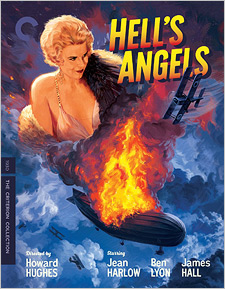
The 2-Disc 4K Ultra HD release of Hell’s Angels sits in a clear Amaray case alongside a 1080p Blu-ray with an insert featuring new artwork by Sam Hadley; and an accordion-style booklet containing cast and crew information, the essay The Sky Is the Limit by Fred Kaplan, restoration information, production credits, and special thanks. The following extras are included on the Blu-ray:
- Interview with Robert Legato (11:59)
- New Interview with Critic Farran Smith Hehme About Jean Harlow (27:07)
- Outtakes with Commentary by Harlow Biographer David Stenn (4:35)
Interview with Robert Legato – Legato, visual effects supervisor on The Aviator (2004), a film about director Howard Hughes, discusses his research into Hell’s Angels and the difficulties he encountered in recreating its daredevil aviation stunts. Hell’s Angels put Hughes on the map. It dealt with what he wanted to express himself. When the film was screened for Legato at MGM, he was impressed with how “the achievement then was remarkable.” The plane choreography was difficult and dangerous and resulted in a “Busby Berkeley-like ballet” in the sky. Miniatures used in movies are actually quite large, often a quarter of the size of the original. This is necessary to show details. Legato’s research revealed how photographic (in-camera) effects were accomplished. Accompanied by behind-the-scenes footage, Legato discusses how he achieved some of the visual effects on The Aviator. About the technicians who worked on Hell’s Angels, Legato says “a genius then is a genius today.” Hell’s Angels is the film Howard Hughes was destined to make. He had a passion and the money to support it.
Interview with Farran Smith Nehme – Critic Nehme notes that Hell’s Angels was Jean Harlow’s first major screen role. She recounts the actress’ rise from obscurity, meteoric stardom, and sudden end. Critics at the time agreed that Harlow was no actress, but she became a sex symbol of the 1930s. She came from an upper class background. Her mother felt she had been thwarted in her own acting career and focused her aspirations on Jean. Harlow worked her way into films as an extra and in bit parts. Hell’s Angels was shot and completed as a silent just as talkies were emerging and theaters didn’t want to book silent pictures. Hughes ordered all the dialogue sequences to be re-shot, retaining the costly and exciting aerial footage. Harlow got the role in Hell’s Angels through James Hall, with whom she was having an affair. Director James Whale had open contempt for Harlow and her limited acting ability though in her flirtatious scenes she’s very good. On screen, Harlow looked wonderful. Nehme discusses the Multicolor process used for the party sequence, which required special cameras and lighting that caused the set to become extremely hot and uncomfortable. Hell’s Angels is the only film featuring Jean Harlow in color. The film had its premiere at Grauman’s Chinese Theater. Hughes sent Harlow on a publicity tour for the road show engagements and shortly thereafter loaned her out to other studios. Some of her best-known films are The Public Enemy, Platinum Blonde, Dinner at Eight, and Red-Headed Woman. She died while shooting Saratoga at MGM and the production had to be completed with a body double.
Outtakes – Footage of Howard Hughes and cast at work on Hell’s Angels is accompanied by commentary recorded in 2024 by David Stenn, author of Bombshell: The Life and Death of Jean Harlow. The source of the outtakes in unknown and its existence is surprising since there was no reason to keep the footage. Among the outtakes is an eleven-second kiss between Harlow and Ben Lyon.
Hell’s Angels was released the same year as All Quiet on the Western Front. The films deal with World War I from different perspectives, one from the infantryman fighting in the trenches, the other from the fighter pilot doing battle in the clouds. Hell’s Angels glorifies aviator/fighters by showing their incredible expertise piloting open cockpit planes with gunfire coming at them from all directions. The excitement and action would be unsurpassed in movies for years to come.
- Dennis Seuling w/Tim Salmons
(You can follow Tim on social media at these links: Twitter, Facebook, BlueSky, and Letterboxd. And be sure to subscribe to his YouTube channel here.)