
Misericordia (Blu-ray Review)
- Review Date: Oct 02, 2025
- Format: Blu-ray Disc
-


Director
Alain GuiraudieRelease Date(s)
2024 (September 30, 2025)Studio(s)
Les Films du Losange (Criterion Premieres/The Criterion Collection)- Film/Program Grade: B+
- Video Grade: A
- Audio Grade: A
- Extras Grade: B-


Review
Sometimes a person will unlock the repressed sexual desires of others without intending to. Whether it’s that person’s appearance, manner, or charm, the allure is unmistakable to those under the spell. The attraction isn’t supernatural but some undefined quality that others find irresistible. In Misericordia, director Alain Guiraudie focuses on such a character.
After several years away from the fictional village of Saint-Martial and the surrounding forests in the South of France where he grew up, Jeremie Pastor (Felix Kyzyl) returns for a funeral. The deceased, Jean-Pierre Rigal, was the town’s only baker and Jeremie’s mentor. As there was no need for another baker in town, Jeremie moved to a city and manages a bakery there. It becomes clear that Jeremie was secretly in love with his mentor.
The baker’s widow, Martine (Catherine Frot), who’s old enough to be Jeremie’s mother, invites him to stay in her home for the funeral and then for an unspecified time thereafter because she doesn’t want to grieve alone. This enrages her adult son, Vincent (Jean-Baptiste Durand), who believes Jeremie wants to sleep with his mother and feels himself being marginalized.
There’s sexual tension between Jeremie and other characters: Martine, who shares with Jeremie love for her late husband; Walter (David Ayala), a large, crude man whom Jeremie knew as a teenager; and the local priest, Phillippe Grisolles (Jacques Develay), who confides his desire for Jeremie and makes clear he knows about Jeremie’s love affair with Martine’s husband. Vincent, hot-blooded and openly hostile toward Jeremie, may either feel he must compete with Jeremie for his mother’s affection or may have a repressed homosexual desire threatening to reveal itself when the two men get into increasingly violent tussles.
The second half of the film switches gears suddenly when Vincent goes missing and a search is undertaken. Jeremie was the last-known person to see Vincent alive. He concocts a story about his involvement with Vincent in which he tries to make Vincent’s disappearance sound credible. His story is shaky at best and only brings greater suspicion from others in town and an official investigation by the police. The local pastor steps in, but it’s to help Jeremie for personal reasons. As the film progresses, we wonder how long Jeremie can keep up his pretense before it’s finally shattered by the truth, and the suspense drives the rest of the picture.
Kyzyl is an interesting choice for Jeremie mostly because of his blandness. He’s the last person you’d expect to be so sexually magnetic, and that might be the point. Whatever the quality is that Jeremie possesses (and he himself is often surprised by it), it’s not about physical beauty or irresistible wit but something hard to define. Were a traditionally handsome actor cast in the role, a basic thread of humor would be lost. Kyzyl plays Jeremie as an innocent set down in a Gallic Peyton Place. He projects a consistent look of “Who me?” as events unfold, and his expression hardly changes when he’s suspected of manufacturing a phony alibi.
Director Guiraudie starts slowly, taking time to let us get to know the various characters. He holds our attention with a number of unexpected twists and one major one about halfway through the film. The film is odd in an often darkly comic way and fairly straightforward in its sexual undertones. Jeremie’s moral struggle and the priest’s role simultaneously grow in prominence. Aside from a few chance interactions, the intertwining of Jeremie and the priest begins with a shocking scene in a confessional. Though the film’s title—Latin for mercy—is never spoken on screen, this scene communicates what constitutes such a concept, most notably forgiveness of both the other and oneself. As the priest, Develay is excellent, with an acute sense of comic timing and a dialogue delivery that’s equally convincing, comforting, and self-serving.
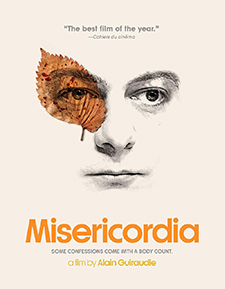
Misericordia is a peculiar film but a definite original. While introducing a collection of colorful characters, director Alain Guiraudie deals with themes of morality and mercy and their often overlooked ramifications. The ironic ending, which a character angrily predicts early in the film, actually takes place but it’s unclear whether it’s a result of circumstances or was Jeremie’s intention all along.
Misericordia was captured digitally by director of photography Claire Mathon with RED Raptor cameras and Zeiss Supreme Radiance and Supreme lenses, and presented in the aspect ratio of 2.35:1. She captures the physical decay of the village as well as the natural beauty of the surrounding woods. The picture quality on the Blu-ray overall is excellent, with forest scenes especially vivid. The color palette is varied, ranging from the vibrant greens of the forest to the darker hues of the men’s clothing. Details are well delineated, such as clothing patterns, items on Martine’s kitchen table, Walter’s ramshackle cabin, colored leaves covering the forest floor, mushrooms, and a photograph of Martine’s late husband.
The soundtrack is French 5.1 DTS-HD Master Audio. English subtitles are available. Dialogue is clear and distinct. Sounds of nature—birds, wind, rustling leaves, rain—are subtle touches that add to atmosphere. Sound effects include bodies being pummeled in a fight and earth being shoveled onto the late baker’s coffin. Marc Verdaguer’s score is effectively balanced with dialogue, bridges scenes, and underscores dialogue-free sequences.
Bonus materials on the Blu-ray release from The Criterion Collection, which features a booklet with an essay by Imogen Sara Smith, include the following:
- Meet the Filmmakers: Alain Guiraudie (17:41)
- Trailer (1:56)
Meet the Filmmakers: Alain Guiraudie – In this original interview for the Criterion Channel, director Alain Guiraudie notes that he writes novels and makes films. Misericordia is his seventh film. A few situations were drawn from a 1000-page novel called Rabalaire with “lots of twists and turns, lots of characters, lots of locations.” He extracted a few characters, a few situations, and a single location to streamline the story for film. He attempted to mix tragedy and comedy and, unlike in his three previous films, desire and eroticism do not conclude with a sexual act. The film deals with religion and empathy and the nature of forgiveness. Novel writing is a lonely process; filmmaking, once the screenplay is written, is a communal activity with many individuals collaborating to bring the director’s vision to fruition. Guiraudie speaks about filmmaker Ingmar Bergman, whose films reflect his presence. In Misericordia, the conversations between Jeremie and the priest suggest themes in Dostoyevsky. Guiraudie understands village life and the way people take an interest in each other, and feels nostalgic about that world. In the film, the characters’ relationships are complex and constantly evolving. The director notes the difference between love and lust and says it was important to “give eroticism back to the people,” not just young, attractive people. During the editing stage of filmmaking, another point of view can emerge, causing conflict between director and editor until the truth of the scene emerges. Guiraudie has learned to scrap footage if it doesn’t serve a purpose. He reiterates the unofficial rule of good writing—“Less is more”—and prefers writing to all other phases of the filmmaking process. Writing is when he’s “dreaming” of the film he wants to make.
Misercordia plays with our preconceptions and expands our ability to forgive someone for the permanence of a solitary act of aggression. The film is captivating, but has a few drawbacks. Director Guiraudie never makes clear why Jeremie’s and Vincent’s shared past might have caused Vincent’s aggressive manner, and Jeremie’s unpredictable shifts in behavior aren’t fully motivated. This adds a layer of weirdness to his character, but never allows those actions to shine a light on his reasons. Martine remains an enigma. Is it really only grief that impels her to invite Jeremie to stay for an unspecified time, or is something else on her mind? Director Guiraudie uses dark humor to enter psychosexual territory in a tale of the unexplainable attraction of so many for a bland visitor who throws their staid lives into a state of repressed desire.
- Dennis Seuling